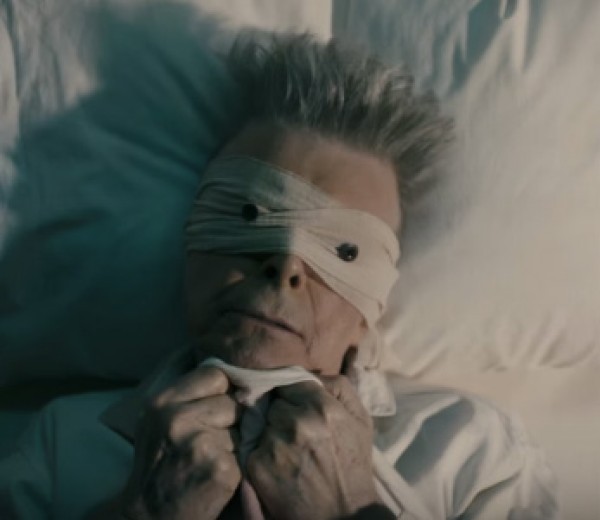
I was quite sad and dismayed to find that my favorite singer and performer passed away last night. David Bowie was so influential to the art community, not only as a musician, but as a composer, actor, filmmaker, and painter. He passed away at 69, right after releasing his final music video from the Blackstar album, which was released 4 days before his death. As bummed as I am over the death of Mr. Stardust, it seems to give his recent videos more substance, in addition to the inherent metaphors and conspiracy theories for the world to run wild with.
"Blackstar" and "Lazarus" were the two videos that were released prior to the release of the Blackstar album on January 8th, both sharing the same director; Johan Renck. The two videos also share a few characters, but mostly the theme of impending death. Its no secret that Bowie has reportedly released the content in a timely manner before his death, but Im interested in what his purpose was in creating such spiritual and symbolic content. It would seem as though that through the allusions to Lazarus, the Biblical figure who rose from the grave 4 days after his death, seem to symbolize the legacy that Bowie is leaving. Will we perhaps see some sort of publicity stunt or posthumous media release?

The "Lazarus" video, while much simpler and shorter than the 10 minute "Blackstar" video, seems to have a more distinct purpose; to show Bowie in very personal states, that is, performing from a hospital bed, which has been where he has spent much time the previous 18 months battling cancer. The previous video relies more on ideas and ambition, while "Lazarus" feels more symbolic and intentional. Its hard not to draw conclusions from the imagery, especially the final shot of Bowie returning to the closet he originally exited from.
Renck seems to have an affinity for creating abstract worlds without a sense of cohesion, and these two videos are no exception. According to an interview with Renck, the videos were simply a collaboration between the two artists, riffing on ideas, and just making something they both enjoyed, without relying on any intentional symbolism or narrative. It seems the perfect working relationship between two ambitious artists who could care less about perceived notions implied by onlookers. Rencks other work for Lana Del Rey and Bat For Lashes shows his affinity for a drab color palette and ability to create a surreal world within a familiar environment. Hes also got this way of lighting peoples eyes- in the few shots where Bowie wasnt wearing a button laden mask, his eyes are so black that you cant help feel creeped out.
Overall, both videos rely on loose metaphor and blatant abstraction to create the experiences, but you cant help but argue the intent of Bowie and Renck to give a sort of planned goodbye to those people who care enough to try and see something special in these pieces of fine art. However, I cant help but think that Bowies relationship to music videos seemed to come in the wrong time, seeing that most of his efforts were put into this stage shows- seen clearly in the full length concert video Ziggy Stardust and the Spiders from Mars The Movie. Here you can see the amount of production that went into his costumes, set pieces, and makeup. Some of these aspects are reflected in a few of his early videos, such as "Life on Mars," but the reality is that the limitations of the time period constricted the exponentially creative efforts of Bowie. Basically, if the music video industry was as developed in the 1970's as it was in the 1990s we likely would have seen many more creative and groundbreaking videos from him. But fact of the matter is that at the very least, we got to see a new wave of Bowie videos over the last few years that undoubtedly redeemed his awkward period in the early 90s.