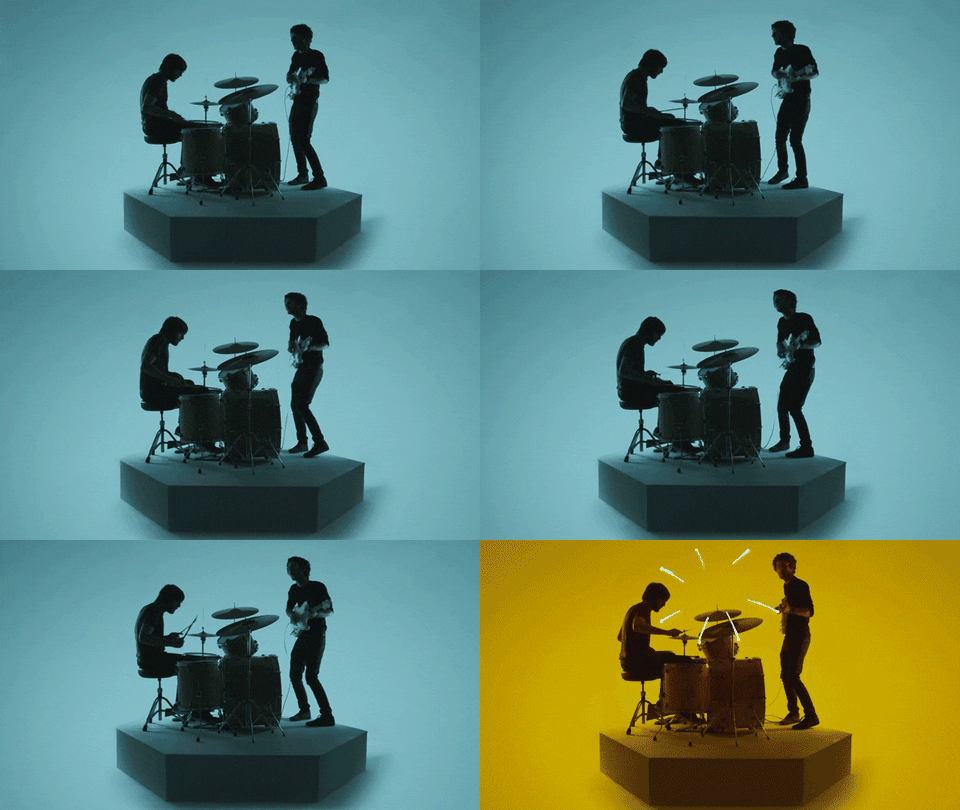
Tom Banks is a prolific cinematographer who has worked with a variety of three-named directors, such as Carlos Lopez Estrada, Hannah Lux Davis, Chris Marrs Piliero, and Eli Gunn-Jones (he has also worked with several two-named directors). Tom has an awesome blog where he talks about a variety of cool things pertaining to his work, and this week, he also sat down with us to talk about a variety of cool things pertaining to his work.
Doug: Do you prefer to work with a variety of directors on more of a project to project basis, or do you prefer to work with a small set of directors and build a rapport with them?
Tom: Its always helpful. The more I work with someone, the more we become in tune, and we get in a routine. We understand each others styles and working methods. On the other side of things, its always great to meet someone new and theres a chance that you might really get along well with them.
Doug: Is there a difference in the approach when youre working with someone thats new? Do you start to build some reference points and stuff with people that youve worked with over time, or is it just as easy to work with someone for the first time?
Tom: It depends. If you have the chance, its usually about just trusting each other.Really getting to know them and where theyre coming from. Usually it takes a little while, but if you have the chance to go out to dinner, really go through a lot of preproduction before the first job, once youre on set, it feels a little bit more natural. For directors Ive worked with a lot, its easier just because I know where their strengths and weaknesses are, and where I can step in when maybe theyre not as visually oriented. I know to take charge with coming up with the shots or vice versa. The directors, Young Replicant, they are very strong visually so I can trust that they will take care of that. Coming up with a storyboard and stuff, it just helps me know where to fill in the blanks.
Doug: About the notes you get from directors, I notice that you share a lot of that stuff on your blog, along with a lot of other content: lighting diagrams, camera set ups, that kind of thing. Do any directors ever ask you not to be so candid with what you share on your blog?
Tom: Ive had one director that was like, Dont say this and that, which is usually not related to the job and its more of a paranoia. Some of my gaffers will say, dont tell all our secrets. The directors themselves, I havent really heard any negative feedback from from them about the blog.
Doug: Directors will talk about how a DP will come along with their own crew of technical, a crew to help shoot and help them do their job. Do you have a set of guys that you always bring around with you to help you to achieve your goals?
Tom: Definitely, as much as possible. Ive had quite a few guys, especially one of my gaffers, Eric Ulbrich, thats been with me, off and on, for like four years, ever since I graduated. Theres definitely like a sixth sense from working with him and he knows where I want my lights, and the colors I like to use. It creates a general workflow for the job and it alleviates a lot of responsibility on my end, just because I can trust him to follow through in the preproduction end and on set.
Doug: Do you think theres a certain style that you think people are trying to achieve when they hire you to work on a job, or is it more of a collaborative effort to come up with that look on each project?
Tom: I think, maybe until recently, my job is to execute whatever is right for the project because Ive done a lot of different videos. From Hannah Lux Davis to Tim Nackashi, and they all span a wide range of style and whats appropriate for the song and the artist. Only recently, a lot of the Young Replicant videos Ive done have gotten a lot of exposure online, so people know me more for that style. I can usually tell when Im going into the job or working with someone for the first time, theyll reference those videos and that they might be going for some style like that, so its a little bit of both.
Doug: I want to ask about the use of lights and lens flares in your video, particularly the pop videos. A lot of times youll see that stuff and youll assume as a viewer that it was just put in post. Do you think that there is something thats particularly more effective about putting elements like that in the actual production of the video, rather than laying it into the back-end?
Tom: I think if you really know you want, its good just to get it on camera because then you can control it, or at least can supervise it and know where the lens flare is happening and whether its turning out well. I do, a lot of the times, recommend that we do in post, whether we shoot plates at the end of the day on set, or theres plenty of plug-ins these days that can get you pretty good looking lens flares. Depending on the set-up, whether the cameras locked up, its easy to add a lens flare, but if its moving around all the time it sometimes can be really delicate putting the light just outside of the frame to get that nice perfect flare, while not totally ruining your frame if you happen to pan over and see it.
Doug: When it comes to the camera choice on a video, is that something that youre choosing, or is that something typically the director picks?
Tom: I always ask the director first in our first conversation if they have any. There are plenty of choices, but most of the videos tend to be either Epic, which is the most popular. If they have the money, Alexa. If they dont have the money, Scarlet. I finally graduated from having 7D as an option.
Doug: You no longer consider the 7D an option? Have the budgets just passed the need for that type of camera?
Tom: I guess Ive graduated to where you dont have to take the budget level that would consider a 7D. I think theyre still a good camera, and Ive definitely seen a lot of good work on them, but as far a real robust film camera, obviously the 7D isnt that. If it was me shooting my own personal projects, Im sure the 7D is what I would be working on, or something equivalent.
Doug: If budget wasnt an option, is there certain camera that you would prefer to be working with, or is it youre just open to whatever you think is going to achieve the goals best?
Tom: I guess there are two main determinants on that. The Alexa is really a simple camera, the post workflow is really simple and the way it works is really reliable. Thats probably the go-to default, if budget wasnt an option. But, if theres any high-speed work being done, obviously the Epic can do 300 frames, so thats always a major advantage. Some directors rely a lot on the reframing in post, so having the original file is definitely an advantage.