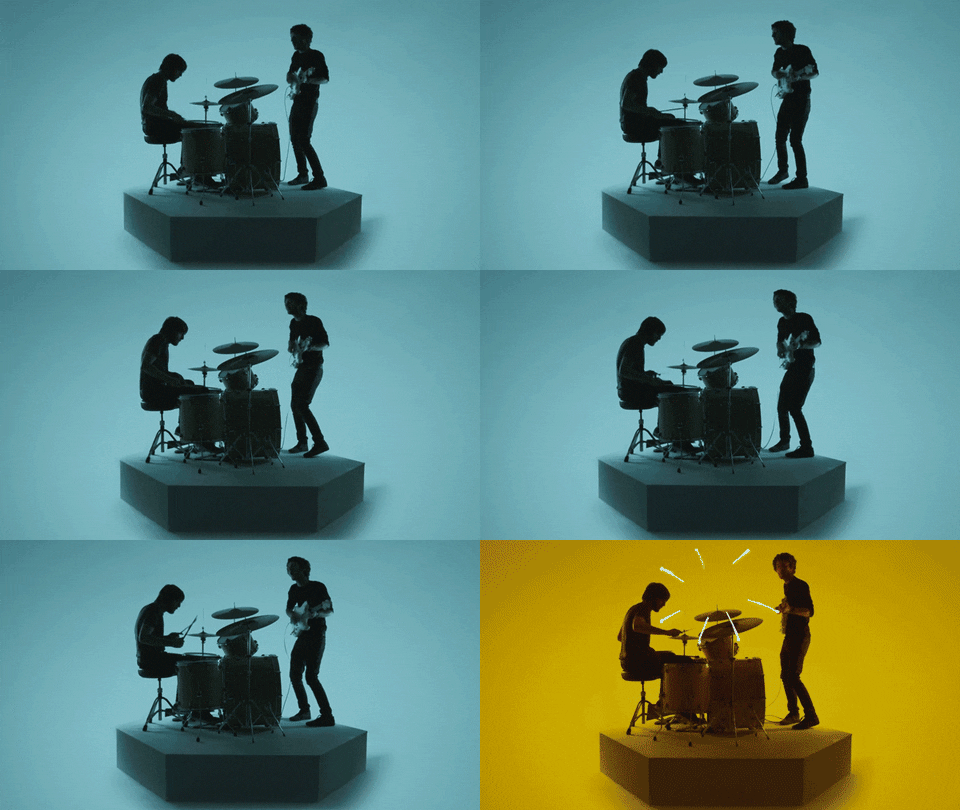
In his music video for Backlines by Stars, Hank Friedmann takes the already difficult task of directing a music video and makes it roughly a billion times harder on himself. In addition to writing, editing, and directing this video, Hank also took on the task of building an antique mechanical arcade from scratch while in a foreign countrya role that is not currently an available credit option in our database. We talked to Hank about how he and Ethan Feldbau were able to build the arcade, and what it was like sleeping in a Canadian studio for two weeks.
Doug: Where did the idea of putting the band in this antique mechanical arcade game originate?
Hank: The song is so compact, its only like two minutes. It never dwells too long in a verse or chorus, it just brushes right along and then it stops. First it reminded me of Band in a Box, which is this thing that I saw in a rural supermarket. It was a compact thing with two banjos, a guitar, and a keyboard. Youd pick a song, and it would play an abridged version of it, then it was over. The song also reminded me of this place called Musée Mécanique in San Francisco, which has a bunch of old, mechanical arcade games from the 1920-60s or so. While those old, mechanical arcade things are cool, theyre never as cool when you look back on them. You put in a nickel, and it does this crazy thing, but it doesnt quite measure up to awesome. I wanted to make the ideal, awesome mechanical arcade machine thats how a child would see it back in the day, with wonderment and imagination. But, in truth, they werent this complicated, so I wanted to make the most complicated antique machine ever.
Doug: And the specific elements in there, the tank, the monster, were they inspired by the lyrics?
Hank: Yeah, loosely inspired by the lyrics. I wanted to shine a light on the lyrics without being too literal that I defuse the meaning. I hooked on the moods of the lyrics, and also there is talk of calling on my backlines, which to me meant something militaristic, like a monster attacking a city, and just calling in reinforcements to save everybody. There is also something in the song that sounds like silos opening and a rocket launching. I heard that, then I got excited, then I drew a picture, and then we made the video.
Hank's original drawing of the arcade concept, taken from his treatment.
Doug: How did you build the arcade itself, did you hire some professional help?
Hank: I knew I wasnt going to be able to do it alone, so I got my old friend and collaborator Ethan to help build it. I definitely dont think I could have done it without him, and I dont think I could have convinced any other individual to do it. Usually, you need a whole shop to fabricate that sort of thing and pay a bunch of people to help make it. We had some help, but it was mostly just me and him locked in the studio for almost two weeks building it.
Doug: You guys shot everything in Canada, including the arcade portions. How did that end up working out?
Hank: Leading up to it, we were going to shoot and build the miniatures in LA, and then shoot the band in Canada, which was more comfortable for both of us. But, the only way to make it work was to go to Canada to build it. So, we slept in the studio. We found a place that would let us build and shoot all of it, and we just lived in our filth for two weeks and shot at the end. It was pretty bad on the health and all that, but it was the only way we could have gotten it done. It was just tougher learning the map to a new city, and finding all their hardware stores. We rented a car, otherwise we wouldnt have been able to do it. Setting up shop in a foreign land was exciting, and everyday was a new challenge. We even had to start up from scratch and buy all of our tools there. Everyone we knew in Canada was busy at the time, so we couldnt borrow anything. We bought a bunch of tools and then just left them all there.
Doug: Did you have to do any research in robotics or anything like that?
Hank: Ethan had the design sense for the arcade as a whole, and he helped shape it. When it came to the actual robotics, we watched a lot of videos and saw how things were done properly, but for the budget we also had to just make it look like it was real robotics when in fact its just people inside the box operating it. That was collaborative between us, just trying to figure out how to Jerry-rig this machine with little sticks, slits in the ground, pulleys and things, all to make it look right.
Doug: So you pretty much used a puppeteer, or a few of them, to get it all to work?
Hank: Yeah, a couple puppeteers and a lot of takes.
Who wouldn't want to live here for 2 weeks?
Doug: Did you build the arcade with shooting it in mind, leaving room for camera sets ups and stuff, or did you build it and then figure out how you were going to shoot it?
Hank: We had it in mind the whole time. From the beginning of the building, all the way through shooting, everything had to be weighed against all options. We could design it vaguely, but we couldnt set anything in stone because it all depended on what we could find. We had to make some accommodations. For example, we were going to shoot it through Plexiglas on the outside, but we had to get rid of that because we needed to get the camera in there. Then we placed things like the moon and the sun so they would complement the shot, everything was build with the camera in mind. We also wanted it to feel like it was just a preexisting machine locked in a dusty warehouse. Its built for a live audience, for somebody to just put a quarter in it, rather than just a camera. But, it worked with the camera, too.
Doug: Was there ever any concern that you wouldnt pull off building the arcade?
Hank: Just budgetary concerns and time constraints. I never felt afraid, but there was some fear. As it was all coming together, all the fear went away because it was all coming together. Ethan and I have already made a lot of videos together with miniatures, and compositing people onto miniatures, so we were pretty confident that it would work out really well. Weve played this game before and it worked out well already. The one thing I liked about this video is that it was so much more compact. Ive put in this much work into a lot of videos, but this one, you see what the machine is and it all intricately works together in front of your eyes, rather than telling this big vast story with a bunch of different miniature sets, where everything is disparate and doesnt really come together. So, I was actually a little more confident about this one.
Doug: As far as getting the band into the arcade, did you just shoot some green screen performance shots, or did you have to hire Rick Moranis to shrink them down?
Hank: No, pretty simple green screen stuff. We tried to get Rick Moranis, but hes retired now.