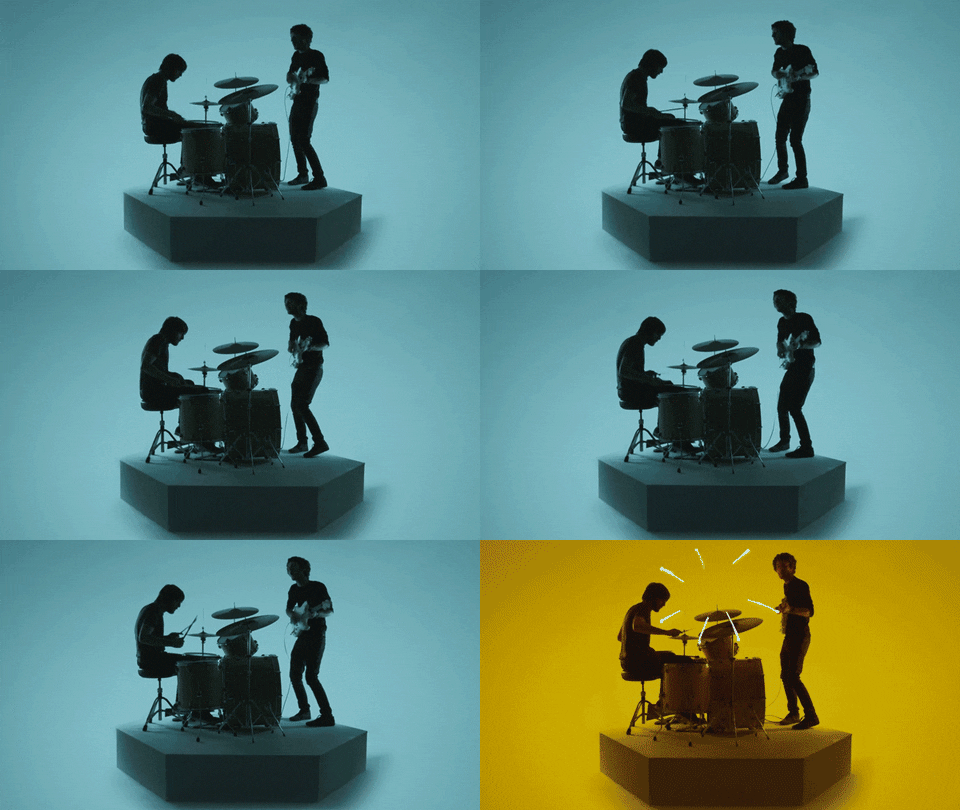
For the second installment on Video Chats, I traveled to New York to hang out with director and photographer Michael Lawrence. Michael was born in Buffalo, New York and currently lives in Brooklyn, but he spent nearly 2 years living in Indonesia, which is where most of his three music videos for Emil & Friends were shot. During his time there, he drew inspiration from the local artwork around [him] and the general surreality of Bali, keeping all his notes in a water-logged black notebook.
Doug: You take on a variety of different projects: commercials, fashion videos, a feature length documentary that youre currently working on. Where do music videos fit into all of that?
Michael: I grew up in a musical family, but I have no musical talent, whatsoever, sort of like Steve Martin in The Jerk, a little bit. It started off just doing that first video for Emil and Friends, who happens to be a good friend of mine. From there, its kind of been an addiction, I feel like anyone thats doing this isnt doing it for the money, theyre doing it because they want to work on these projects and a lot of them offer a lot of freedom. For me, if I can listen to a track and come up with an idea for it and the band is down and we can make it happen, its a chance to break some rules and try stuff out. Perhaps, it parlays into other projects, it has gotten me a fair amount of work.
Doug: In the Crystal Ball music video, that was a six-month production process. Whats the purpose of a music video like that, when its not tied directly into the release of an album or a single or something like that?
Michael: That project came about, I had already been working on another video for Emil, the two part Let Your Heart/Prescriptions video. Prescriptions was positioned as a short film that came out with the album release; Crystal Ball was the next single. I was over in Indonesia still, at the time, working on the production of Prescriptions. They sent a track over and I wrote this crazy idea back to them that was only vaguely scripted. It basically had to do with appropriating all these weird things that were happening around me, at least as a foreigner, living in a foreign land and then trying to cut that together in a documentary, but surreal style into this music video. For me, it was a chance to do a pretty cool project in the sense that it showed my personal travels and it was really based on my experiences and sort of my disillusion at the time with my surroundings. I cant speak for Emil, but I had his full endorsement and I had done a couple videos for Cantora already, so they trust me with it.
Doug: At the time, itself, it was just that you had the freedom, whatever the necessary turnaround time was for the project?
Michael: For the most part, it was supposed to come out more around holiday season and then we still needed to get some pick-up shots and I had just moved back to the US. I asked for an extension on it and then they ended up giving me February/March release dates, so we finished up posts in January.
Doug: You mentioned the Let Your Heart/Prescriptions music video and its hard not to draw connections between that video, itself and your personal story. Its the story of a clearly American looking guy in Indonesia. You spent 18 months of your life in Indonesia, is that video at all autobiographical or is it you were inspired by the area?
Michael: Its totally autobiographical. I was living there because I was inspired by it and working on projects over there. Funny enough, a lot of people who havent met me or they havent seen me in a long time, they actually thought I was the guy that starred in it, and I was originally supposed to star in it and someone else was going to operate cameras. That was totally based off of my personal experiences over there. I had been going through a little bit of a rough personal time then and it was about my relationships, where I was living and trying to seek some, I guess we all are, but trying to find some enlightenment or some calmness or understanding. That was shot over the course of probably two and a half months with production days just set out based upon my own travels. A lot of that was me, on a motorbike, shooting b-roll on a 5D.
Doug: So, very similar. What youre seeing there in that video is a lot of what youre experiences were like.
Michael: Totally, yes.
Doug: I saw another interview that you did with Music Video Theory, where you mentioned that while Indonesia you were going through a period of disconnect, with home, with New York, with your family. Clearly, youre back in New York now because here we are together. Were you able to reconnect yourself or has that remained unresolved?
Michael: Its definitely changed, maybe anyone who has spent a lot of time abroad experiences this where theres a little more beneath the surface, if youre looking at it from like a 45 degree angle and cutting through it. New York feels different to me than it did before I left, for sure. My relationships in Indonesia feels like an ellipses because theres this documentary still happening and I have to go back there and finish some work. Its sorted itself out and were probably all going through these phases and I feel like my lifes changed a hell of a lot since it did Crystal Ball.
Doug: Do you think is that reflected in your work that you put out, compared from then to now, or does that stuff stay consistent?
Michael: I feel like some stuff that actually hasnt come out yet, but that hopefully you guys will see soon, is a little bit more sober and maybe slightly more narrative. There are still these surreal crazy bits because thats how my mind works. But, its a little more cohesive and I feel like my lifes a little more gathered than it was then. I was living out of a backpack for half of that. Traveling on other jobs and it was all shot Like I had been piggybacking and I was DP-ing a couple of documentaries and a couple of music videos, so, whenever I would travel for a job I would take my gear with me and stay a couple extra days.
Doug: I mentioned before the fashion videos that you work on. Thats something were particularly interested in at FilmedInsert because we dont see a lot of the directors we talk to involved in that area. It does seem like there is a lot of crossover esthetically in music videos and in fashion videos, a lot of the looks are the same. Do you agree that there is some crossover there between those two spaces?
Michael: Yes, for sure, I think both of them play with film as a format and allow you to maybe be a little less structured in narrative and dialogue. To look at it as an esthetic visual art more than, lets say, a theatrical medium, thats one way to look at it. For me, personally, it was just that I Kind of randomly I would cast Fahrani, who I barely knew at the time, in Crystal Ball, whos really well known in Asia, at least, as a model. I had this fashiony approach, given that she was in it. I had previously worked as a photographer. After that, a couple drafts came in from Ford and a few other little things here and there and then theres also a couple of things coming out. It felt like there was an overlap just because it was approaching film as an esthetic medium rather than a narrative one.
Doug: Youve done three videos now for Emil and Friends and most of your jobs have then came directly from them and through a personal relationship with that band, is that typically where your work is coming from right now, across all spectrums?
Michael: Yes, for the most part, it has to do with personal relationships with people. Sometimes I have randomly contacted bands and we got to know each other and hit it off. Theres this video for Levek coming out in a couple of weeks for this track, Black Mold Grow and the whole album is awesome. Dave and I met when I was in Florida on kind of a commercial job, like Gainesville/Jacksonville area, six months ago. I just randomly ended up stumbling upon his name and sort of giving him a call and talking and talking and talking then, finally, doing this. Ninety-five percent of the work is all personal relationships and the couple of the more commercial pieces have come through references or recommendations from friends who are on the agency half more. As of now, I still have no formal representation. I did at one point years ago and it actually didnt do much.
Doug: Do you find that youre able to benefit from those personal relationships then because you know the band, they know what your work is and they know you personally, do you think that you benefit from those relationships?
Michael: For sure, I think by knowing someone personally and having a friendship of sorts ahead of time, there is this certain trust and respect. They know the work that you do and you maybe know a little bit where theyre coming from. They can inform, creatively, what you do from a decision-making standpoint. Furthermore, the example on the Emil videos and even on a couple of the Ford videos, where I knew some of those girls personally ahead of time, there is a trust in the director, especially if youre directing them as talent, there is a belief that youre going to make them look good and you believe in them and you personally care about them. You have an incentive to do a good job on this. For me, that seems pretty important, especially when theres not a lot of money in involved. Its like, why else are we doing this? other than for our own interest in music or in the medium and our connection to the people who are involved in this.