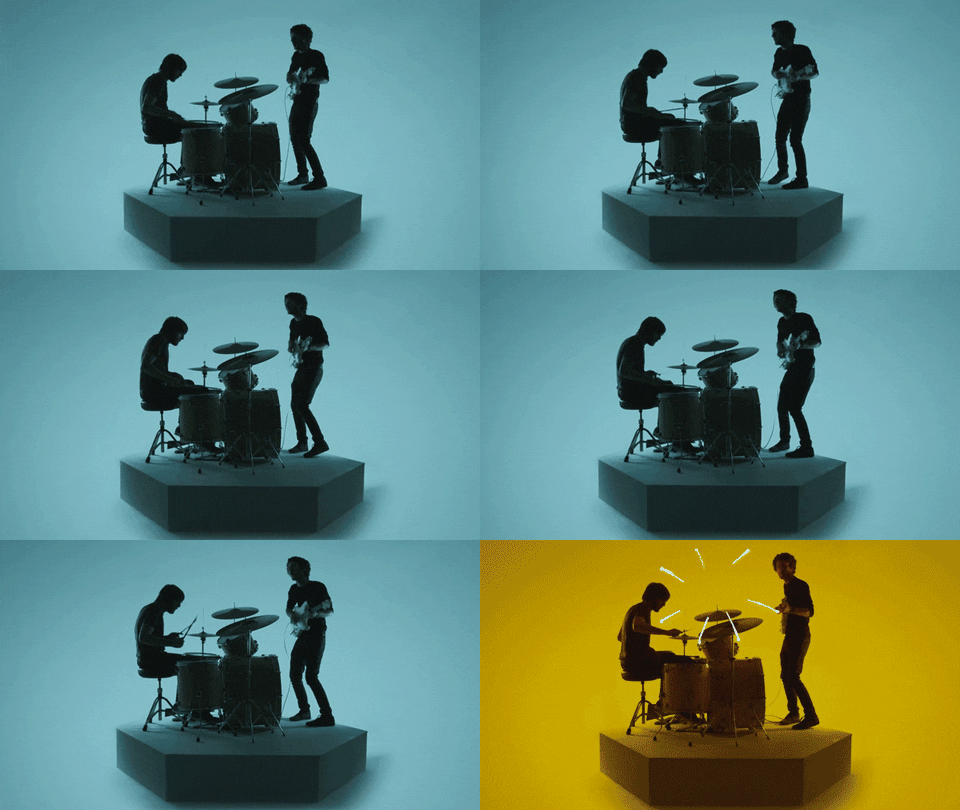
Since back when MTV first came around, stop-motion animation has been used in music videos with great effectiveness. In fact, stop-motion has been such a staple of the music video world for so long, its hard to imagine someone finding something new to do with the technique. That is, unless youre directing duo Kijek / Adamski, in which case coming up with new, unique, mind-blowing ways to use stop-motion is what you do. We talked to Kijek / Adamski about how their latest stop-motion piece, the amazing Katachi by Shugo Tokumaru, was made.
Doug: How are you able to boil down a video like this into a treatment? What does the treatment look like?
Kijek / Adamski: Both Shugo and his record company were kind enough to trust us basing on mostly conceptual treatment. It proves their great imagination as the treatment contained visual references (in this manner.) very losely connected with the final effect
Doug: In the Vimeo description of the video, it says it was created using 2000 silhouettes extracted from PVC plates using computer-controlled cutter. I wonder if you could walk us through the process of creating the silhouettes. Do you upload custom images? Were all the human silhouettes taken from footage that you shot?
Kijek / Adamski: All the human silhouettes were recorded as a green box shots before we proceded with the animation. We made most of the shapes in Adobe Illustrator. Some of them were just made from the scratch, other were altered google images. We gathered all the shapes on 13 large, densely arranged PCV plates and cut.
Doug: Are the particular shapes based on anything, or do they represent a more natural stream of consciousness?
Kijek / Adamski: Concise and pretty abstract poetry of Shugo's lyrics gave us the idea of an infinite chain of memories which are as lax as imperfect is our memory. At the same time this memories strangely pass into the future making unremitting chain of visuals. We basically created a tactile stream of consciousness indeed.
Doug: What are the PVC plates like to animate with? Do they stand up on their own?
Kijek / Adamski: PVC is very solid and easy to operate, all though it's difficult to get rid of production waste in the form of electrostatic chips. PVC plate was 0.5 cm in thickness and it was basically able to stand still on its own but we couldn't lean on fortuity so all the silhouettes were secured with either double-sided tape or a glue.
Doug: What takes place in between coming up with the original idea and cutting the silhouettes? What do you do to write and prepare for the actual video?
Kijek / Adamski: As we said before, it's more of a train of thoughts but we had in mind the composition all the time and we played with meanings of individual elements. Computer animation was preceded by abovementioned live shot, where we tried to give an idea of slightly narrated video. It became canvas for later variations. We took it lightly and improvised a lot.
Doug: Do you have a rough idea of how many hours were put into this video?
Kijek / Adamski: The photo shoot took exactly 24 hours, but it's hard to measure the time of all the preparations. We started in December.