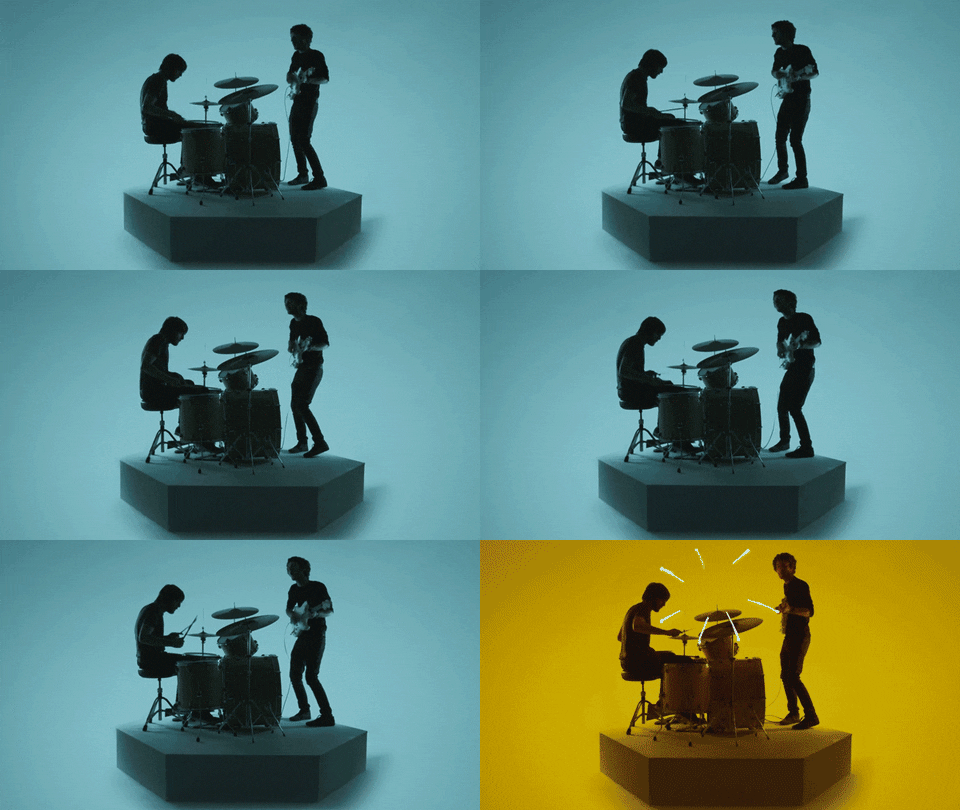
In New Piano by Sumsun, director Alex Pelly combines beautiful driving and nature footage with superimposed shots of the artist shots that were actually a lot more difficult to achieve than they seem. We talked to Alex about the concept behind the video, Palm Beach County, and getting the artist to look natural on camera. (Photos by Alex the Brown)
Doug: Sumsun is interestingly enough from Palm Beach County, which is actually pretty much where Im from. Im curious, especially because of that, about how you got involved with the project.
Alex: Hes on this awesome LA-based label called Halocyan, and Dimitri Fergadis, whos the owner/founder of that label, reached out to me about possibly doing a video for one of his artists. I was super excited when he eventually sent me New Piano.
Doug: The video premiered on Decoder Magazine, and in the write up it mentioned that the video was meant to define the touring side of Sumsun, and it was meant to depict what life on the road is like. Would you say thats a fairly accurate description of what you were after when making this video?
Alex: Actually not at all. I definitely wanted a sense of persistent movement throughout the video, and I can see how that might reflect the life of a touring musician, but I was thinking more about movement and light, and how it progresses throughout a day. Also the furthest I ventured from LA when shooting was Palm Springs, and most of it was shot in or around the LA area.
Doug: When you see a write up thats a miss like that, do you have to just let it roll off your back? Is it not really a concern of yours? Or does it irk you a little bit?
Alex: No, it doesnt bother me actually. I think its fun to see how other people interpret my work. Especially when its a video thats somewhat abstract and not really narrative at all. Its interesting, you start off with an idea, and then you make it and send it out into the world and then people project their own ideas onto it. I totally encourage open interpretation.
Doug: You talked about creating constant movement and light in the video, is that what you were looking to capture when shooting the more nature-style stuff and in the environment scenes, with the close-ups of these more natural elements?
Alex: Yes, that was a big part of it. I tried to shoot all the close-ups at the actual time of day I wanted them to represent, and then I was very conscious of time and light quality when editing and also when color correcting. There is also a lot of sun and reflected sunlight in the video, and I tried to track the suns movement and change in color temperature throughout the day.
Doug: Do you just find an environment and then go nuts shooting everything, and just letting the environment determine what you capture there or is there something specific that youre looking for?
Alex: I definitely had a plan of where I wanted to be at different times of the day. I shot all the outdoor stuff over a few days and the night before Id think, OK, I want to be on the PCH at sunrise, and then I want to be at the Marina right before sunset." Then I would just explore the space through my camera and just capture whatever caught my eye.
Doug: Is it the same for those driving portions? You had a time of day that you wanted to be on those specific roads and then you would let the camera just get what was there?
Alex: Yeah, definitely. A lot of the stuff I actually ended up using was the footage that I shot while I was driving around to shoot the close-ups. For the most part the driving footage was shot around the same time as the close-ups in the same location.
Doug: How does that work? Are you shooting and driving at the same time?
Alex: Yes. It was actually a Go Pro shooting time-lapse while mounted with a suction cup to the top of my car. It was kind of scary at first, it wasnt even my Go Pro and I was like, I really hope this thing stays mounted, but it worked great.
Doug: Did you drive a little slower than you would have otherwise just to make sure it stayed on?
Alex: At first yes, but by the end I was going full speed on the freeway and it didnt budge. Its just this little $30 suction cup thing, but its very effective.
Doug: Im wondering about the performance portions, and I guess hes not really performing the song, but hes just there in the frame and the light is hitting him. What was the process behind that; you guys had a projectionist correct?
Alex: Yeah, we had two projectors, and we shot it in the basement of this building downtown called LA Mart. We had one projector behind Judson (Sumsun) and one in front of him, and we were actually using a lot of the imagery I had already shot and used throughout the video. You can see that pretty clearly with the nighttime stuff where its shining directly onto him, but for the day stuff I wanted the projector behind him, backlighting him. You cant see whats actually being projected, but using the footage that I would intercut it with gave the light some texture and dimension and also helped the coloring match the rest of the video.
Doug: How did you go about directing him?
Alex: That was actually the hardest part for me, because as you said hes not really doing much. Sometimes doing nothing is the hardest thing imaginable to do on camera, especially if youre not a model or actor whos trained to look comfortable in front of a lens. That was one of the biggest challenges for me - just figuring out how to direct him in that situation. We were there pretty much all day, and a lot of it was spent just trying to distract him from the camera without making him move too much or look away from the lens. Matt Amato, whos been a really important mentor to me, taught me to almost never cut the camera if you can avoid it. It makes editing a real pain, but sometimes the best stuff is captured in-between takes when your subject doesnt even know hes being filmed.
Doug: What were some of the things that he was having trouble with? Just looking into the camera or not knowing what to do with his arms, that kind of thing?
Alex: Yeah, basically, but sometimes the more you try to direct someone to do specific actions with their arms, the more stiff it seems. Its better if that stuff comes naturally. I tried directing him to move his arms or shift in a certain way, but the best stuff happened when we would all exchange jokes and I would try to keep him talking about random stuff. Actually, Alex Brown, who ACed for me had some great advice. Being a still photographer, shes more used to shooting people just posing, whereas most of my experience has been shooting musicians performing, or dancers dancing or actors acting out a scene.
Doug: Did you have an idea when shooting where things were going to fit into the edit?
Alex: In my treatment, I had an outline with timecode from the song defining where I wanted to be when. The treatment served as a guide, but things shifted somewhat. I definitely had a pre-planned arc, but then a lot of it came together when I tried to really edit to the song, making images correspond to certain sounds and really focusing on the beat when making cuts.
Doug: What was the input from the artist?
Alex: He was actually really awesome to work with. He had a lot of great insight and contributions to make, but he definitely left me with creative control. I sent Dimitri the treatment, which of course Judson saw, and we had a phone conversation before I started shooting. He liked the treatment, but there were some things that he wasnt so into, and he had some suggestions. I made changes based on his input, and also from what I intuited about his aesthetic from speaking with him (Id never met him before). When I sent him a rough cut, he had some great notes that were really insightful and helpful to the video. Sometimes artists or labels can demand changes that are really heartbreaking to a director, but thankfully that wasnt an issue with this video. I agreed with almost all of his suggestions.