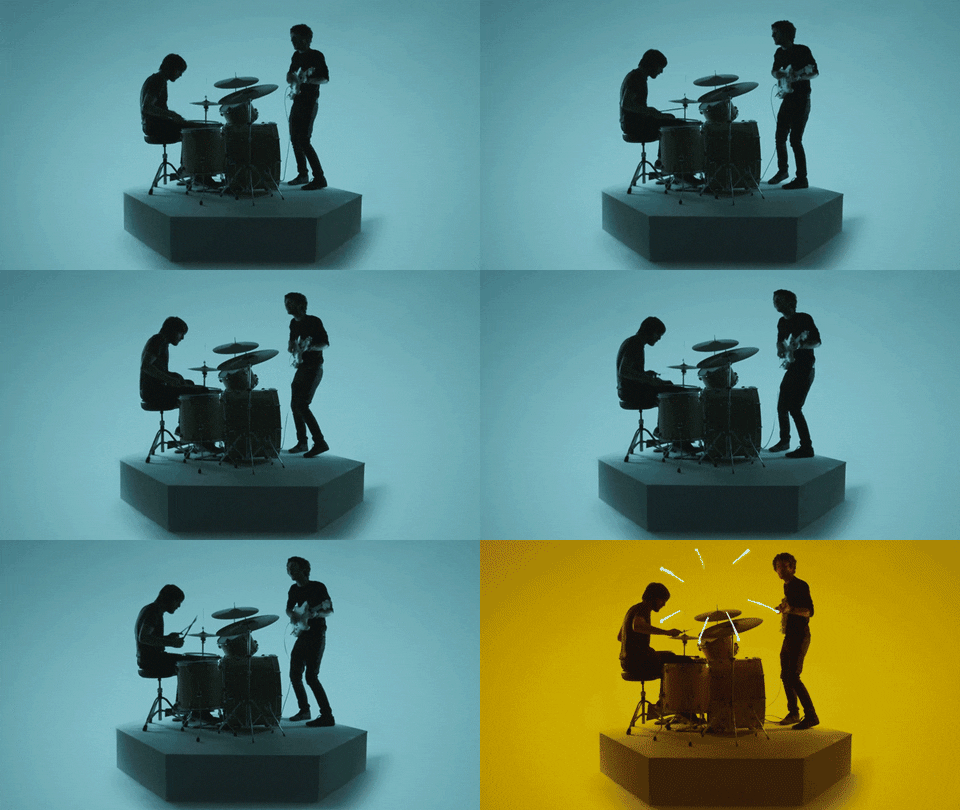
After a 2013 promotion blitz that saw, among other things, an interactive video and a 30 minute post-SNL music film, it seemed only fitting that Arcade Fire's last video release of the year would be a beautiful narrative and concept piece, directed by Montreal-based Emily Kai Bock. Inspired by a dream Emily had, "Afterlife" doesn't feature any members of the band, and was one of our favorites music videos of 2013. We talked to Emily about writing the video, some of her stylistic choices, and finding the perfect cast members at the very last minute.
Doug: The narrative of this video fits so perfectly with the song - was the song a major influence on your story?
Emily: Thank you. I had an initial inspiration before I heard the track, but the process of translating the idea into a story/script went hand in hand with the music. The song came around a time when I was having a lot of very vivid dreams about people I am no longer in touch with, and I was thinking about how my dreams felt like a continuation of a relationship that had ended. The track "Afterlife" seemed like it was meant for the idea. I had wrote out this idea into a script, but it didn't take shape until I was able to piece together the scenes upon the music.
Doug: When writing a narrative video like this are you mainly just mapping out scenes, or do you get more detailed than that?
Emily: I try to use the track as a narrative guide, sometimes I see a scene and it will lead to another scene, it will just write itself based on the beat, an instrument, a lyric, the emotion in the music; all these things steer the story. Then there are things you capture while shooting that veer off the script, then when you reach the edit, you have to start over, using the music again as the blueprints. It's important to stay loose, and keep shooting out of inspiration. You sometimes will capture all these extra moments that sometimes end up marrying the music more then the images you had initially wrote.
Doug: Arcade Fire is a band who seems to put a lot of thought into their music videos. Were they significantly involved in this project despite not appearing in the video?
Emily: I met up with Win Butler in Montreal after I had heard the track. I showed him a rough script and treatment. It was very laid back meeting. He was really open and cool with the idea. He offered a few notes and film references he thought were in the same vein as the concept, such as La Jetée and Black Orpheus. We texted leading up to the shoot. I kept him in the loop but overall, I felt free to see the idea through and make the video I wanted to make, which was a huge privilege to have that level of trust with a band. It felt like a gift.
Doug: I'm curious about the opening shot, with the father character standing in a room in front of a camera, almost as if he is auditioning for something. I wonder if you can give a bit of background on this shot.
Emily: I was interested in adding another layer to the idea of reality vs. illusion, dreaming vs. waking. I thought it would be interesting to show the audience the casting audition, where the actor was being auditioned for the role of the father. Of course there is only a couple seconds, it's not too explicit so it's become more open ended. People have asked if it's alluding to him immigrating into the US, and getting photographed for US identification. It's interesting to think of it like that as well. This is what I meant when I say it writes itself.
Doug: What was behind the use of black and white in many of the scenes with the father?
Emily: I always saw those particular scenes playing out in B&W. The tone and feeling was specific to B&W. Then I started thinking about it on a story level, I liked that it created a divide between the younger son's dreams and the father. I did some research and found out that a large number of the population over the age of 55 dream in B&W, while on the other hand, dreaming in B&W is virtually nonexistent in young people. They say it has to do with growing up on B&W television. I thought that was an interesting phenomenon.
Doug: There is a lot of chemistry between the actors in the video. Was there much time available for the cast to get to know you and each other, or did you guys have to find all of that chemistry on the fly?
Emily: It's funny you should ask that. The father who I originally casted got cold feet the night before the shoot. I got a call from the producer around 10pm saying that he had cancelled and that I had to hold a casting sessions in my living room early the next morning. It was looking pretty grim, I thought the video was going to be a bust, until around the 7th guy, in walked in Pablo Soriano. He was a natural, and was head and shoulders above the rest, even above the actor who had canceled. I basically told him to be on set in an hour. It was a pretty exceptional circumstance. So to answer your question, the actors had no prep time together. The chemistry between them was apparent and was an incredible relief to witness after all the stress.